01 · July 2026
The trouble with talc.
A label tells you what isn't in a jar. It rarely tells you what that absence feels like.
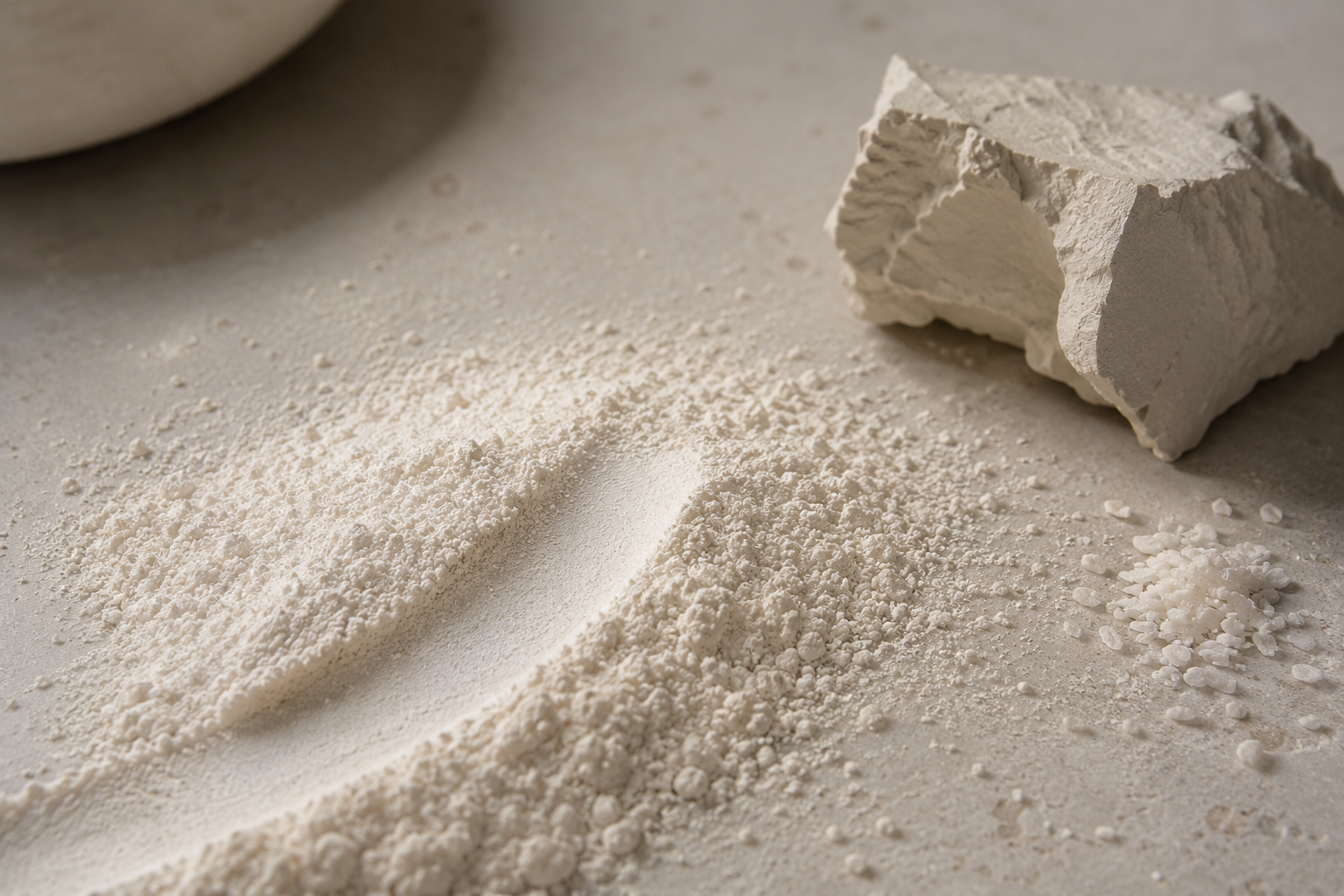
A label can tell you what isn't in a product. It rarely tells you what that absence feels like.
“Talc-free” has become one of those phrases you notice on the back of a jar and file away without quite knowing what it promises. It names a subtraction. What matters is what takes talc's place — and whether the result feels as good against the skin as the thing it replaced.
What “talc-free” actually means
Talc is a soft mineral, mined and milled to a fine powder, long valued for one particular quality: it glides. For generations it was the default in body powders because it does what a powder is asked to do — ease friction, absorb a little moisture, leave a smooth, dry finish.
“Talc-free” simply means a formula reaches that finish without it. The phrase describes what a powder is made of, not whether it's good. What makes it worth understanding isn't the mineral that's missing; it's the small library of ingredients that have learned to do the same work, often with a softer hand.
What takes its place
Most talc-free powders are built on plant starches and fine mineral clays, and each has a character of its own.
Cornstarch is the familiar one — cushiony, matte, quietly absorbent. Tapioca starch, drawn from cassava, feels lighter and more silken, with a slip that reads as almost weightless. Arrowroot sits between the two: powder-soft, quick to disappear into skin. Rice starch lends a velvety, blurred finish — the kind that softens the look of skin as much as the feel of it.
Then there is kaolin, a gentle white clay. Where the starches cushion, kaolin manages moisture and lends a dry-touch quality — a matte composure that keeps a powder from ever feeling heavy or pasted on.
Formulators rarely rely on a single one. The pleasure of a good talc-free powder lives in the blend: enough starch for softness, enough clay for that settled, dry finish, balanced so the whole thing seems to vanish the moment it meets skin.
Why the feel is the point
Here is what a label can't convey. A well-made talc-free powder isn't a compromise, a stand-in for something better. At its best it feels like a veil — weightless, barely there, leaving skin dry to the touch and quietly comforted, as though friction has simply been asked to settle.
That is the reassurance worth choosing for. Not anxiety about what you're avoiding, but pleasure in what you've chosen: a texture that feels considered, ingredients you can picture, a finish that holds through heat and movement without ever announcing itself.
The quiet version
This is the thinking behind Underbloom, our talc-free comfort body powder — a soft, weightless veil built from modern powder ingredients and finished with a fragrance so minimal it reads as skin rather than scent. Less a product you notice than a feeling you keep.
Talc-free, in the end, is only a starting point: a single word on a jar. What matters is everything that comes after it — how it settles, how it lasts, how it feels at the end of a long, warm day.
— Robin
Follow the Work